Institutional Research, Planning, and Effectiveness
Mission Statement
The mission of Institutional Research, Planning, and Effectiveness (IR) is to support assessment, strategic planning, and institutional decision-making by collecting and providing timely and accurate data, as well as insightful analyses based on qualitative and quantitative research.
Key Functions
IR is a vital contributor to:
- the collection of SUNY Westchester Community College (SUNY WCC) census data in conjunction with the constituents of the College
- the submission of official external reporting to federal, regional, state, county, and other agencies
- research and analysis to aid decision making at all levels of the College
- survey administration and analysis
- data governance efforts across the institution
- deployment and development of interactive Tableau dashboards as well as other forms of data visualization
Data Governance
Policy on Data Integrity
In accordance with the charge of the Data Governance Committee, SUNY Westchester Community College is committed to:
- the high integrity of college data to ensure consistency and integration across college units
- ensuring processes regarding data collection and usage are transparent and consistent
- reviewing institutional data retrieval processes to ensure compliance to current rules and regulations for all reporting agencies
- documenting existing and new processes and decisions
Procedures on Data Integrity
The following procedures are required:
- Departments that oversee or enter student data in PeopleSoft must ensure that data are entered correctly and on time. Any changes must be communicated to the Data Quality Team (DQT) prior to implementation to ensure data integrity and accuracy in reporting.
- Errors detected in Weekly Data Audit Reports must be addressed and corrected in a timely manner.
- IR reviews the submitted data for accuracy and consistency.
Reporting
The office of Institutional Research, Planning, and Effectiveness collects and submits official census data to Integrated Postsecondary Education Data System (IPEDS), Middle States Commission on Higher Education (MSCHE), New York State Education Department (NYSED), State University of New York (SUNY), and other external agencies for SUNY WCC.
- At the beginning of the academic year, IR shares the SUNY and IR calendar of mandated reports to all college constituents to which they must adhere.
- IR contacts departments whose assistance is required at least 3 weeks ahead of reporting deadlines. Departments responsible for completing the reports or sections of the reports must complete the requirements by the communicated deadline.
- In accordance with the IR calendar deadlines, data are frozen, cleaned, and submitted to SUNY for official SUNY WCC census reporting.
- The census data are used to report to external agencies.
The office of Institutional Research, Planning, and Effectiveness responds to various ad hoc requests for data and analysis. These requests may be tied to internal queries, external queries, or grants.
College employees may request data directly from IR. College students may request data from IR when sponsored by a college employee. Depending on the nature of the inquiry, IR may redirect data requests to the College’s Institutional Review Board (IRB) for clearance. In most instances, IR only shares aggregate data, not personally identifiable data.
Data requests should be made using the Data Request Form. IR will contact the requestor for clarification if necessary.
- IR requires at least 15 business days to complete a request.
- If the requested data are not immediately available, IR will inform the requestor in a timely manner. The requestor may choose to wait, adjust the data request, or withdraw the data request. This includes instances when the request asks for non-census data that are not finalized.
- While working on the data request and after completion, the IR office may request a meeting to discuss clarifications or findings.
Survey Policies and Procedures
Surveys are used often at SUNY Westchester Community College to gather input from various stakeholder groups to assess and improve programs and services at the College.
The College’s survey policy ensures:
- methodological accuracy in survey design, administration, analysis, and reporting
- adherence to high and consistent standards of quality for surveys conducted on behalf of the college, maintaining the integrity of the college’s reputation
- Minimization of duplicate data collection and survey fatigue by combining data collection needs whenever possible and appropriate, and managing the number and timing of multiple surveys to the same group of respondents
- appropriate distribution and utilization of survey results
Surveys conducted at SUNY Westchester Community College must undergo review and approval by the Assistant Dean of Institutional Research, Planning, and Effectiveness or designee before administration. Exclusions may apply to feedback loops or evaluations.
Survey participation must be voluntary, and prospective respondents must be free to opt out of any survey without penalty. Surveys must clearly communicate to respondents whether the survey responses are confidential and/or anonymous. Unless the survey explicitly requests permission to share identifiable information, all survey data must be presented in an aggregate form. While survey requestors may choose to offer incentives to respondents, IR is not responsible for the incentives but can facilitate this process.
All surveys must contribute to the benefit of the institution and its constituents and should not be intended for personal research. Surveys of a personal nature should be redirected to the College’s Institutional Review Board (IRB). The Assistant Dean of IR may accept, alter, or reject survey requests to align with this policy.
College constituents are required to complete a Survey Request Form available on the Institutional Research, Planning, and Effectiveness website:
The office of Institutional Research, Planning, and Effectiveness will:
- maintain an annual schedule of surveys shared with College constituents
- manage a survey archive
- review and approve survey requests
- prioritize and schedule surveys based on the needs of the College, ensuring timely data collection and minimizing survey fatigue and duplication of effort
- provide consultation on the implementation and administration of surveys, as well as analysis of results
- utilize the Qualtrics survey tool to design and administer surveys and generate reports
2025 – 2026 Newsletter
Welcome from Dr. Yelizaveta Adams
Welcome to the Spring 2026 edition of the Institutional Research (IR) Newsletter!At SUNY Westchester Community College (WCC), data play a central role in how we understand our institution and strengthen our work. They give us insight into students’ experiences, help shape institutional priorities, and support decisions that affect the College’s future. Over the nearly twenty years I’ve worked in Institutional Research, I’ve seen how careful, intentional analysis, especially when paired with collaboration, can lead to meaningful and lasting impact.The mission of the office of Institutional Research, Planning, and Effectiveness is to support assessment, strategic planning, and institutional decision-making by collecting and providing timely, accurate data and delivering insightful analyses based on qualitative and quantitative research, including predictive analytics and advanced modeling. Our work is focused on helping SUNY WCC remain responsive to the evolving needs of our students and the broader community we serve.
This issue highlights several projects completed over the past year in support of the College. You will find summaries of a small fraction of the work we do, along with resources designed to make institutional data more accessible and actionable. I encourage you to explore our Fast Facts brochure for a concise snapshot of institutional metrics, as well as our Study of the Graduates report, which offers insight into post-graduation outcomes. Our interactive Tableau dashboards,including the Fact Book, Student Profile, and Transfer Reports, are valuable tools to support planning and decision-making across campus. These and other resources are available on our website at www.sunywcc.edu/ir.
This semester, we administered SUNY’s Student Satisfaction Survey, which gathers student feedback on academic programs, services, and campus facilities. The results help institutions identify both strengths and areas for improvement. While we await SUNY’s compiled reports,results from Spring 2024 survey, along with other internal survey findings, are available on MyWCC under the Institutional Research and Planning tile. If you have specific data needs or would like support with survey design or analysis, please submit a request through our online forms. We are always glad to partner with you.
We deeply appreciate the ongoing collaboration with our colleagues across the College. Your engagement is essential to building and sustaining a strong, data-informed culture, and we look forward to continuing this work together.
Warm regards,
Dr. Yelizaveta Adams
Assistant Dean
Institutional Research, Planning, and Effectiveness
[email protected]
Reporting Processes at SUNY WCC
Accurate, reliable data are essential to SUNY WCC’s operations, supporting compliance, funding, planning, assessment, and informed decision making. While dashboards and reports are the visible outcomes, they rely on extensive behind-the-scenes work—especially data cleaning,validation, and coordination.
This work begins at the source. How data are entered, how systems are configured, and how changes are communicated all directly affect data quality. Although time-intensive, these steps are critical to maintaining strong data integrity and require ongoing collaboration across departments.
Before reporting can occur, updates to systems or processes must be planned and clearly communicated. When changes take place, notifying key stakeholders in advance allows adjustments to be properly mapped to SUNY’s Institutional Research Information System (SIRIS),helping prevent downstream errors and ensure consistency throughout the reporting cycle.
Siris Reporting and Data Quality
Each semester, SUNY WCC submits several required files to the SUNY Data Transfer System (DTS),including Course, Term Section, Early Student Submission (ESS), and End of Term (EOT) files.Additionally, Degrees Awarded files are submitted twice a year, and Student Financial Aid data are reported annually. During each cycle, all fatal errors, and select warnings, must be resolved before final submission, requiring timely coordination and cross-departmental collaboration.Under the coordination of the Institutional Research office, the Data Quality Team supports this work and helps ensure SUNY’s reporting standards are met accurately and consistently.
SUNY has expanded reporting requirements in recent years through new mandates, often referred to as SUNY Updates. These include additional student-level data related to initiatives such as SUNY Reconnect, State-Supported Internships, English and Math Gateway courses, and developmental placement, further emphasizing the need for clean data and clear communication.
At the close of each academic year, credit hours and tutorial contact hours are aggregated to calculate the Annual Average Full-Time Equivalent (AAFTE). Because this metric directly affects institutional funding through state reimbursement, accuracy throughout the reporting process is especially critical.
Where to Find Reports
In addition to SIRIS submissions, IR produces routine internal reports:
- Monthly FTE Reports (credit, non-credit, extension sites, ELI, high school partnerships, ECE,remedial) are generated on the 15th of each month and stored at: O:\Enrollment Reports\IRMonthly Reports\
- Daily credit enrollment reports, used for tracking trends and supporting SUNY WCC’s AI-driven enrollment forecasting model, are available at: O:\Enrollment Reports\IREnrollment Reports\
The Impact of Scholarships on Student Success
One of the core functions of the office of Institutional, Research, Planning, and Effectiveness is to support institutional decision-making through timely, relevant, and insightful analyses. Members of the College community are encouraged to contact IR or submit a data request form whenever they need data to inform planning, assessment, or program development. The example below highlights how IR data have been used to support the WCC Foundation and its scholarship efforts.
The WCC Foundation sought to understand how students who received Foundation scholarships performed through the lens of one of the College’s most important outcomes measures: the IPEDS150% graduation rate. As a first step, IR identified the appropriate student population. IPEDS graduation metrics focus on first-time, full-time, degree or certificate-seeking students who enter in a given fall term. Once students meet these criteria, they are included in the IPEDS cohort for that year and tracked over time.
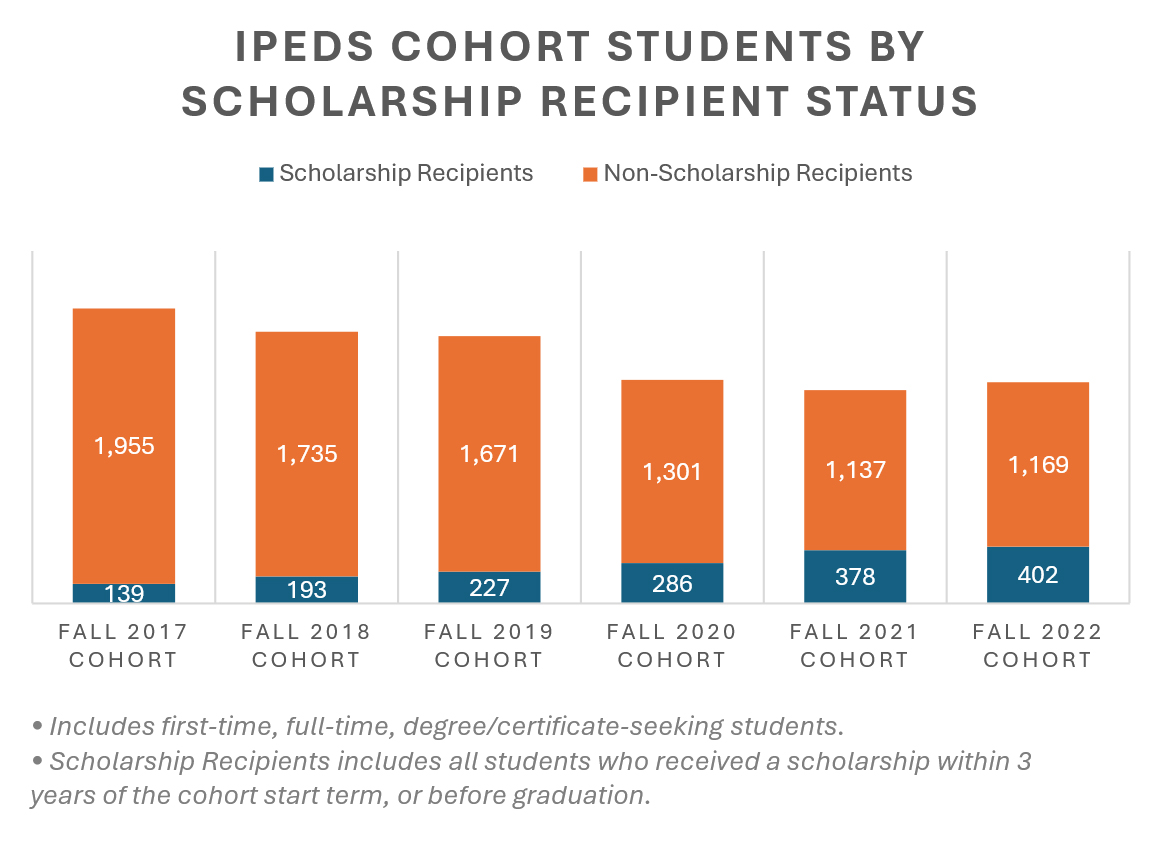
For this request, IR examined which students in each IPEDS cohort received a Foundation scholarship within three years of the cohort start term. The analysis showed that participation in scholarship programs has increased over time. In Fall 2017, only 139 students in the IPEDS cohort received a scholarship, while by Fall 2022, that number had grown to 402 students.
The next step was to determine graduation outcomes for scholarship and non-scholarship students. The IPEDS 150% graduation rate measures whether students complete their program within 150 percent of the standard time to degree — three years for associate degrees and 1.5 years for certificate programs.
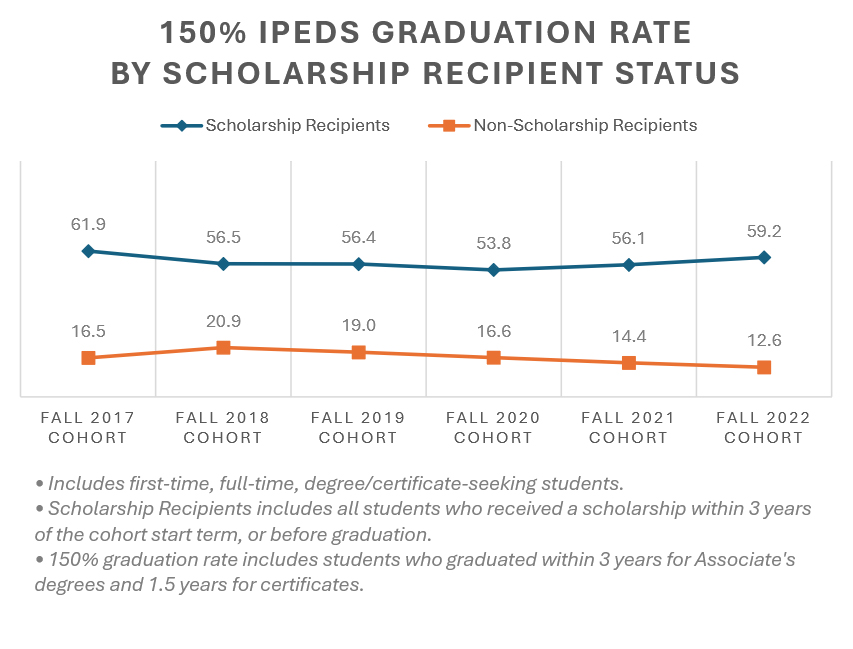
The results indicate a clear difference in outcomes. Students who received scholarships consistently graduated at a much higher rate than those who did not. Although the graduation rate for scholarship recipients declined between the Fall 2017 and Fall 2020 cohorts, it rebounded in the most recent cohorts, reaching 59.2 percent for Fall 2022. In contrast, graduation rates for non-scholarship students have declined steadily since the Fall 2018 cohort.
These findings have helped the WCC Foundation demonstrate the tangible impact of scholarships on student success when communicating with current and prospective donors. The data have also supported outreach efforts across campus by reinforcing the importance of encouraging eligible students to apply for scholarships. Overall, the data underscore how financial support can play a meaningful role in student completion and long-term outcomes.
AI-Driven Enrollment Forecasting at SUNY WCC
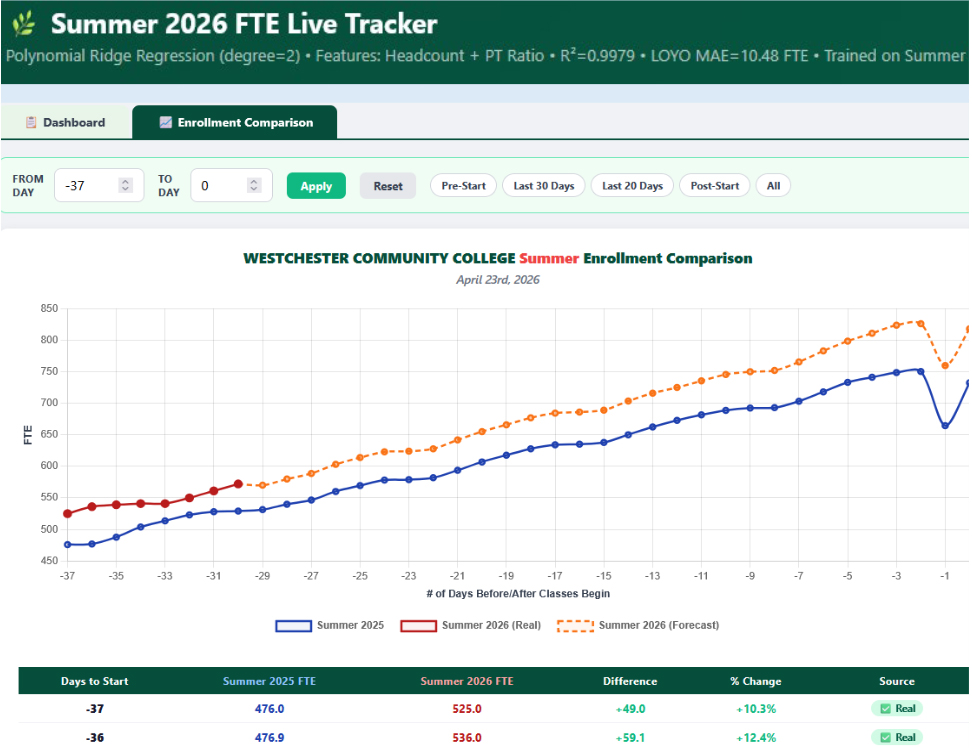
The office of Institutional Research, Planning, and Effectiveness built SUNY WCC’s first internal Artificial Intelligence/Machine Learning (AI/ML) model — and it’s already running.
Predictive Modeling for Enrollment & FTE
The model tracks daily student registration numbers, as well as full-time equivalents (FTEs) – a measure used to convert credit hours into full-time student headcount. Using historical enrollment data, the model forecasts what registration is likely to look like on any given day of the enrollment cycle, offering a clearer view than end-of-term summaries alone. Rather than waiting until the end of the enrollment cycle to understand outcomes, the College now receives daily forecasts while enrollment activity is underway. This shift matters. Decisions related to staffing, course sections, and resource allocation can be informed by where enrollment is trending, not solely by what happened in prior terms.
What’s Next: Local AI Models
The office of Institutional Research is continuing to expand a broader set of predictive tools developed specifically for SUNY WCC. These models are designed with our campus in mind,drawing on our own data, enrollment patterns, and student population, rather than adapting generic frameworks.As this work evolves, deep learning and predictive analytics are becoming part of how the College plans and makes decisions. The foundational infrastructure is now in place, and we will continue to build on it to support more timely, data-informed planning across campus.
Spotlight: IR Leadership Beyond the Campus
Naomi Dogani Elected President of State-Wide Institutional Research Organization Naomi Dogani, Assistant Director in the office of Institutional Research, Planning, and Effectiveness, has been elected President of the Association for Institutional Research and Planning Officers (AIRPO). She will officially assume this role at the organization’s annual convention in Saratoga Springs this summer and currently serves as Vice President.
AIRPO supports professional development, collaboration, and effective higher-education management among institutional research professionals across all 64 campuses of the State University of New York (SUNY), including community colleges, four-year institutions, and doctoral-granting universities. Naomi’s election reflects SUNY WCC’s continued commitment to evidence-based practice and leadership within the institutional research community.
In addition to her work in Institutional Research, Naomi is an adjunct professor and has been recognized for her service and leadership, including receiving the SUNY WCC Staff Excellence Award in 2020 and the SUNY Chancellor’s Award in 2023.
Please join us in congratulating Naomi on this momentous accomplishment!
Listening to Our Students : What Surveys Tell Us
At SUNY WCC, surveys play a vital role in our commitment to assessment, reflection, and continuous improvement. By regularly gathering feedback from students and graduates, we gain valuable insight into their experiences, helping us understand what’s working well, where we can improve, and how our programs and services are making a difference.
These surveys are more than just data points; they amplify student voices and inform decision-making across the College. Recent results from our First-Year and Continuing Student Surveys highlight important trends in who our students are and how they experience learning at SUNY WCC.
First-Year Student Survey Highlights
One key shift reflected in the most recent First-Year Student Survey is the changing profile of students before they began attending SUNY WCC. When asked about their primary role prior to enrollment, 40.9 percent of students identified as full-time or part-time employees, while 35.9percent reported being high school students.
This represents a change from the Fall 2024 survey administration, when high school students were the most common group among first-year respondents. The shift may point to a growing presence of career changers, adult learners, and students seeking to update or expand their professional skills, underscoring SUNY WCC’s role in serving learners at many stages of their educational and career journeys.
Continuing Student Survey Highlights
Results from the Continuing Student Survey reflect strong relationships between students and faculty. More than four-fifths (82.9%) of respondents agreed or strongly agreed that they felt respected by their professors, and 80.0 percent indicated that faculty care about their success.Student engagement with faculty remains a key strength. Nearly three-quarters (73.1%) of continuing students reported engaging with faculty for extra academic support, and 71.7 percent noted that professors encouraged them to persist when facing challenges. These finding sreinforce the importance of faculty mentorship and support in helping students stay motivated and succeed.
Learn More
By listening closely to our students, SUNY WCC continues to strengthen teaching, learning, and support services ensuring that data-informed decisions remain at the heart of institutional improvement. These highlights represent just a portion of the insights gained through SUNYWCC’s survey efforts. Full results, including SUNY’s Student Satisfaction Survey (SSS) and the College’s First-Year, Continuing, and Non-Returning Student Surveys, are available to faculty andstaff through MyWCC > Institutional Research & Planning.
Learn more about SUNY Institutional Research
SUNY’s Office of Institutional Research and Data Analytics produces a wide range of useful reports and resources and allows campuses to benchmark outcomes across SUNY, including comparisons among community colleges. SUNY IR supports system-wide planning and decision-making by collecting, analyzing, and disseminating data across SUNY’s 64 campuses. Its publications include the SUNY IR Fact Book, Executive Data Summaries, and a variety of comprehensive interactive dashboards, such as Grad Wages, Campus Fact Sheets, and analyses of Non-Credit Instructional Activities, among other things. These data and resources are used by campuses and system leadership to support institutional effectiveness efforts.
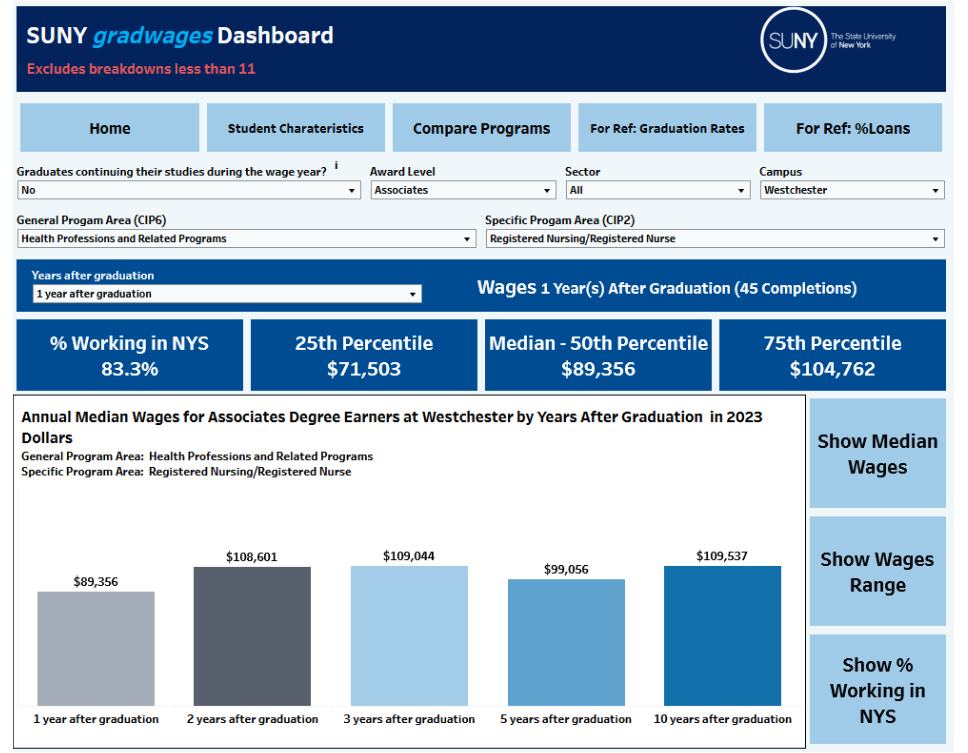
The SUNY Graduate Wages dashboard provides insight into graduates from SUNY institutions,allowing the SUNY community to explore graduates’ employment rates and wages.
For example, the dashboard shows that 83.3 percent of Nursing graduates from 2019 to 2022were employed in New York State one year after graduation. The median wage one year after graduation for Nursing graduates was $89,356. These data can be disaggregated by major, and faculty, staff, and administrators can view graduates’ employment status and wages from one year to ten years after graduation.
Thank you for your partnership!
Collaboration really is at the core of what we do in the office of Institutional Research. We are grateful for the many conversations, questions, and partnerships we share with faculty, staff, and administrators across the College. Your willingness to engage with data helps us better understand our students and supports ongoing improvement throughout SUNY WCC.
We appreciate your continued partnership in using evidence to inform decisions that advance student success and strengthen institutional effectiveness. Together, we are fostering a culture of informed planning and shared responsibility across the College.
If you have questions, data requests, or would like to learn more about available IR resources,please visit www.sunywcc.edu/ir, access MyWCC under Institutional Research & Planning, or contact us at [email protected].
Thank you for your collaboration and commitment to data-informed practice at SUNY WCC!
IR Request Forms
These form are used by departments when requesting data information for program review, datasets, Survey Requests and SEM Data Requests. Please allow at least 15 business days for processing.